


1.Packed Absorption Tower
Introduction: A packed tower is a mass transfer device that uses packing inside the tower as the contact component for gas and liquid phases. The tower body is a vertical cylinder. A packing support plate is installed at the bottom, and packing is placed on the support plate either in random packing or structured packing mode. A packing hold-down plate is mounted above the packing to prevent it from being blown away by upward gas flow. Liquid is sprayed onto the packing from the tower top via a liquid distributor and flows down along the packing surface. Gas is fed from the tower bottom. After distribution by a gas distributor (gas distributors are generally omitted for small-diameter towers), gas flows countercurrently with liquid continuously through voids of the packing layer. Gas and liquid phases come into intimate contact on the packing surface for mass transfer. The packed tower is a continuous-contact gas-liquid mass transfer equipment. The composition of the two phases varies continuously along the tower height. Under normal operating conditions, the gas phase serves as the continuous phase while the liquid phase acts as the dispersed phase.
Advantages: High production capacity, high separation efficiency, low pressure drop, low liquid holdup, and great operational flexibility.
Disadvantages: High cost of packing; inability to effectively wet the packing surface at low liquid loads, which reduces mass transfer efficiency; unsuitability for materials containing suspended solids or those prone to polymerization; and less suitability for complex distillation processes involving side-stream feeds or withdrawals.

2. Cooling Tower
Function of a Cooling Tower: In industrial production processes, waste heat is typically removed using cooling water. The function of a cooling tower is to facilitate heat exchange between this waste-heat-laden cooling water and the surrounding air, transferring the waste heat to the air, which is then released into the atmosphere. For example, in a thermal power plant, a boiler heats water into high-temperature, high-pressure steam, which drives a turbine to generate electricity. The exhaust steam from the turbine enters a condenser, where it exchanges heat with cooling water and condenses back into liquid water, which is then pumped back into the boiler for reuse. During this process, the waste heat from the exhaust steam is transferred to the cooling water, raising its temperature. This heated cooling water then releases its thermal energy to the air within the cooling tower, and the heat is subsequently discharged into the atmosphere through the tower's exhaust stack.
Applications: Cooling towers are primarily used in air conditioning cooling systems, refrigeration systems, injection molding, leather tanning, foam manufacturing, power generation, turbine operations, aluminum profile processing, air compressor systems, and various other industrial water-cooling applications. They are most extensively utilized in air conditioning, refrigeration, and the plastics and chemical industries.
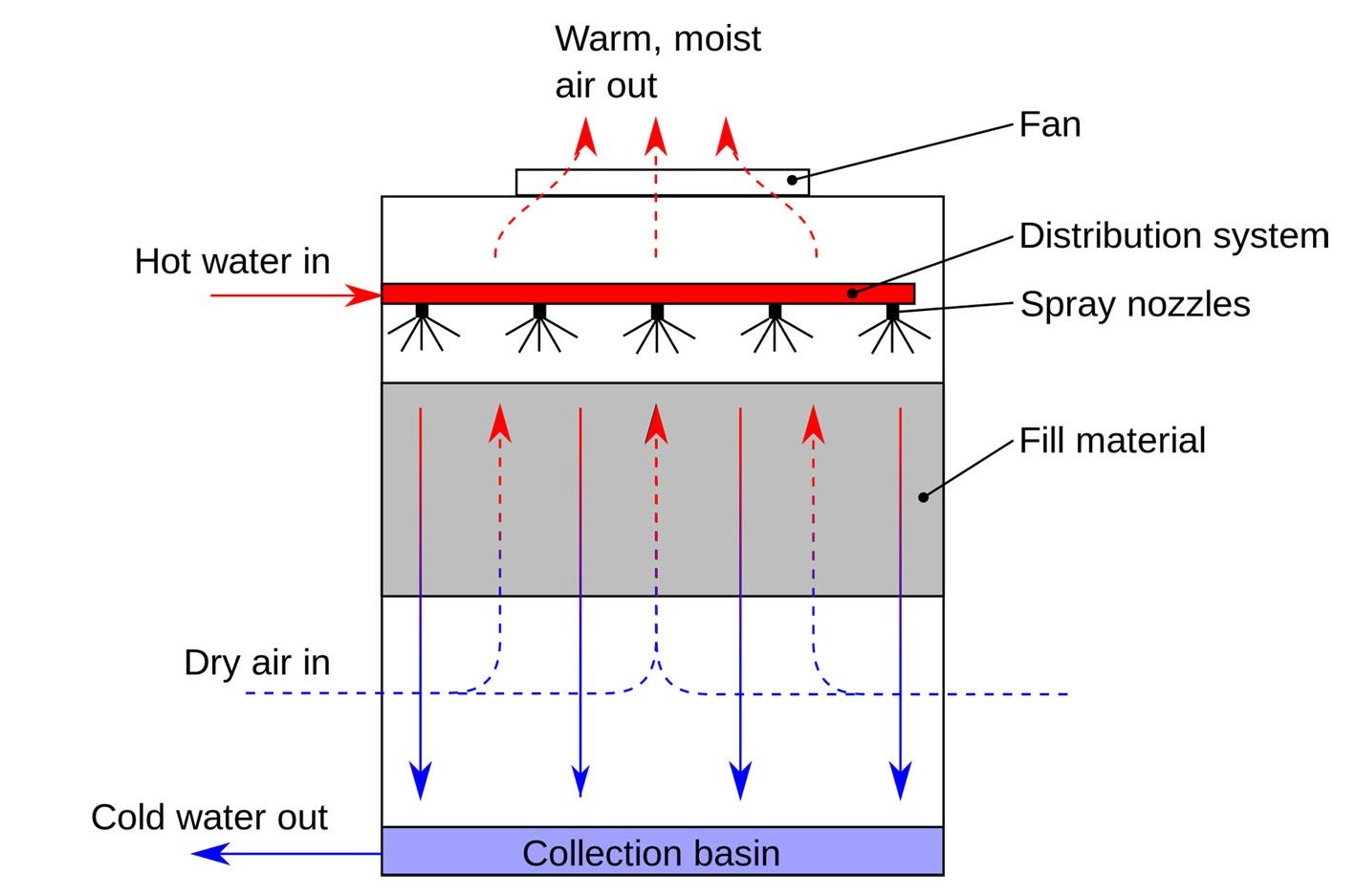
3. Packed Extraction Tower
Working Principle: The structure of a packed extraction tower is essentially the same as that of a packed tower used for distillation or absorption. The tower is filled with appropriate packing material. The light liquid phase enters from the bottom and exits at the top, while the heavy liquid phase enters from the top and exits at the bottom. During the extraction process, the continuous phase fills the entire tower, while the dispersed phase is broken into droplets by a distributor; these droplets then enter the packed bed, where they come into contact with the continuous liquid phase to facilitate mass transfer.

4. Scrubber
Introduction: A scrubber is a new type of gas purification equipment. It is developed on the basis of floating packing layer gas purifiers and widely used in pretreatment such as industrial waste gas purification and dust removal with excellent purification performance. For coal gasification processes, coal gas scrubbing is indispensable and adopted in all coal gasification technologies. It is named scrubber because its working principle resembles a washing process.
Features:
- Water-washing waste gas treatment system with low cost and simple treatment process;
- Vertical structure, optimal for space-saving installation;
- Applicable to gaseous and liquid pollution sources;
- Treats single pollution source;
- Suitable for medium and low air volume.
5. Fractionating Tower
Working Principle: Maximize the heat exchange area of liquid mixture within limited space. Mixtures used for rectification and fractionation are generally organic azeotropes. After heating in the reactor, azeotropes rise to the fractionation section. Components with lower boiling points keep rising. Since the tower top temperature equals the boiling point of low-boiling components after heat transfer, low-boiling substances are fractionated out. Higher-boiling substances fail to reach their boiling points, get cooled and reflux back to the reactor or the lower half of the fractionating column. After low-boiling components are completely distilled off, medium and then high-boiling components are sequentially fractionated, and residues remain at the bottom of the reactor.


